


Gas Fireplace BTU: What Homeowners Should Know

BTU ratings appear on almost every gas fireplace specification sheet, but the biggest number is not automatically the best choice.
A fireplace with a higher BTU rating can use and potentially deliver more heat, but comfort depends on much more than one number. Room size, ceiling height, insulation, open floor plans, windows, fireplace efficiency, and how the homeowner plans to use the fireplace all matter.
For anyone comparing gas fireplace options for West Michigan homes, understanding what a BTU rating actually tells you can make product comparisons much clearer.
What Does BTU Mean?
BTU stands for British thermal unit, a standard measurement of heat energy.
In fireplace specifications, BTU per hour is used to describe heating capacity or fuel input. The U.S. Department of Energy defines a BTU as the amount of heat required to raise one pound of water by one degree Fahrenheit.
That definition is useful, but homeowners do not need to calculate water temperatures when shopping for a fireplace. The practical takeaway is simpler: BTU gives you a way to compare the heating characteristics of different products.
DOE provides the formal British thermal unit definition for additional background.
Input BTU and Output BTU Are Different
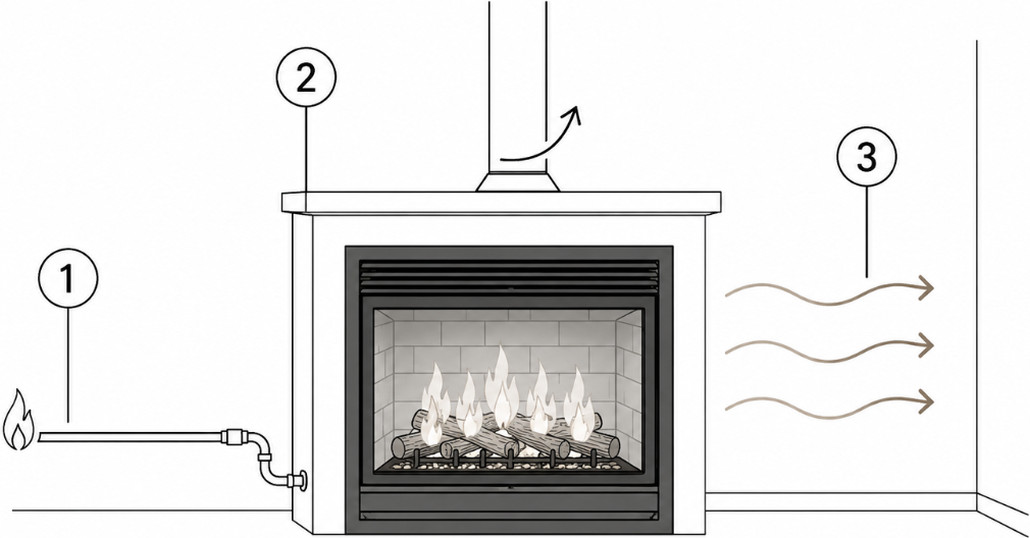
- Input BTU
- Fireplace system
- Heat output
One of the most important details is whether a specification refers to input or output.
Input BTU describes the energy entering the appliance through the fuel it burns.
Output BTU describes the heat the appliance delivers after system losses are considered.
Those numbers are not always identical. Official fireplace specifications may list both values, which is why two products should be compared using the same type of rating.
For example, Napoleon installation documentation shows separate maximum input and maximum output BTU ratings for several gas fireplace insert models.
Homeowners and builders can review an official example of gas fireplace input and output ratings.
A Higher BTU Rating Is Not Automatically Better
A fireplace should fit the heating goal of the room.
If a fireplace produces more heat than the space needs, homeowners may find themselves turning it down or using it for shorter periods. If the fireplace is expected to provide meaningful supplemental heat but has limited output, it may not meet that expectation.
The better question is not, "Which fireplace has the most BTUs?"
It is, "How much heat do we actually want from this fireplace?"
Start With the Heating Goal
Homeowners often want a fireplace for one of three general reasons:
1. Primarily for Ambiance
The flame and atmosphere are the priority, while strong room heating is less important.
2. Supplemental Comfort
The fireplace should add noticeable warmth to a living room or gathering area while the home's main heating system remains in use.
3. Greater Heating Performance
Heat output is a major part of the purchase decision, especially during colder weather.
Clarifying the goal first makes the BTU number more meaningful.
Room Size Matters, but Square Footage Is Only the Start
It is common to compare fireplace output with room size, but square footage alone does not describe the complete heating load.
A 400-square-foot enclosed family room and a 400-square-foot area connected to a kitchen, stairway, and hallway may behave very differently.
Other factors include:
- Ceiling height
- Insulation
- Window area
- Exterior walls
- Open doorways
- Vaulted ceilings
- Air movement between rooms
- West Michigan winter conditions
This is why simple BTU-per-square-foot rules should be treated as starting points rather than precise fireplace-sizing instructions.
Open Floor Plans Can Change the Heating Picture
Warm air does not stop at the edge of the living room when that room opens directly into other spaces.
An open-concept great room may share air with a kitchen, dining area, hallway, or staircase. A vaulted ceiling also increases the volume of air within the space.
When comparing a fireplace, consider the area the heat can actually move into, not only the dimensions printed beside the living room on the floor plan.
This is another reason fireplace selection should consider the complete room layout as well as the BTU rating.
Minimum BTU Can Matter Too
Homeowners often focus on maximum heat output, but some gas fireplaces also list a lower or "turn-down" BTU rating.
This tells you how far the fireplace can reduce its firing rate while continuing to operate within its designed range.
A wider operating range can be useful when homeowners want stronger heat on a cold evening but less heat during milder weather.
Regency's gas fireplace specification matrices show how maximum BTU ratings, vent types, dimensions, and other specifications can vary across fireplace models.
Efficiency Changes How the BTU Number Should Be Read
Two fireplaces with similar fuel input do not necessarily deliver identical useful heat to the room.
Fireplace design, venting, heat-exchange systems, and tested efficiency all influence performance.
That is why homeowners should avoid comparing one model's maximum BTU number without also reviewing how the manufacturer describes efficiency and heat output.
BTU is one specification. It is not a complete efficiency rating.
Fireplace Size and BTU Are Separate Decisions
A visually larger fireplace does not always mean it has the highest heat output, and a smaller fireplace can still produce substantial heat.
Width, viewing area, firebox proportions, and BTU rating describe different things.
Homeowners should therefore consider both:
- How the fireplace fits the wall and room visually
- How its heating characteristics fit the intended use
VanderWall's guide to fireplace size, proportions, and viewing area provides additional guidance on the visual side of selection.
Heat Management Features Can Affect Comfort
Modern gas fireplaces may include blowers, heat-management systems, remote thermostatic controls, or other features that influence how heat is distributed and managed.
These features do not replace the BTU rating, but they can affect how homeowners experience the fireplace in the room.
When comparing products, ask:
- Does the fireplace include or support a blower?
- Can the flame or heat level be adjusted?
- Is a thermostat or remote control available?
- Does the model offer a heat-management option?
- How is heat directed into or away from the room?
Do Not Choose BTU Without Looking at the Exact Model
BTU ratings belong to specific products and configurations.
Fuel type, model size, installation requirements, and manufacturer specifications can all matter. Builders should work from the current documentation for the exact fireplace selected rather than using a general BTU number from another model in the same series.
Homeowners can compare gas fireplaces in person at VanderWall's Spring Lake and Grand Rapids showrooms.
Seeing fireplaces operating makes it easier to compare flame appearance, viewing area, heat level, controls, and overall scale together instead of evaluating specifications in isolation.
Questions to Ask When Comparing Gas Fireplace BTU Ratings
- Is this BTU rating input or output?
- What is the maximum BTU rating?
- What is the minimum or turn-down rating?
- What room size or application does the manufacturer associate with the model?
- How efficient is the fireplace?
- Does the space have high ceilings or an open floor plan?
- Is the fireplace mainly for ambiance or supplemental heat?
- What controls or heat-management features are available?
- How does the fireplace size fit the wall?
- Can I see the model operating before deciding?
How VanderWall Helps Compare Fireplace Performance
VanderWall Brothers works with homeowners, builders, and contractors across gas, wood, electric, insert, and stove options.
The team can help clients compare BTU ratings alongside fireplace size, venting, installation requirements, room layout, and the way the fireplace is expected to be used.
Through fireplace support throughout West Michigan, clients can explore options for Grand Rapids, Spring Lake, Holland, Grand Haven, Muskegon, and surrounding communities.
BTU Is One Part of Choosing the Right Fireplace
BTU ratings are useful because they help describe the heating characteristics of a gas fireplace.
They should not be treated as a contest where the largest number wins.
The right fireplace depends on the heating goal, room layout, ceiling height, efficiency, operating range, fireplace size, and how much warmth the homeowner actually wants.
Understanding input, output, maximum, and minimum BTU ratings turns the specification into something more useful: a way to compare fireplaces based on how they may perform in the finished home.
If you are comparing gas fireplace sizes, BTU ratings, or heating options for an upcoming project, talk with the VanderWall team. Call (616) 842-4500 or visit www.vanderwallbros.com.
What we do
This is work we take on
Reading up is the first step. When you want it built, priced or supplied, these are the pages that cover it.
Keep reading
Why Are My Pavers Sinking? Causes and What to Check
If your paver patio has started to dip, rock, or collect water in one area, the problem usually begins below the…
How Much a CMU Block Weighs and Measures, Width by Width
A block has no single weight. It has a width, a density and a shape, and all three move the number. That matters to a…
Stone Veneer Around Windows and Doors: Builder Guide
Manufactured stone veneer around windows and doors is not only a finish detail. It is also a water-management and…
Thinking about a project like this?
Reading about it only gets you so far. Tell us the room and we will tell you what is possible in it.
Rather just ask someone?
Call the showroom. If it takes two minutes on the phone we would rather tell you than have you read around it.