
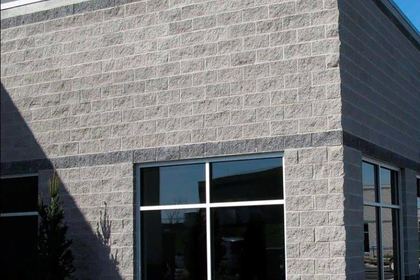
Buying Cultured Stone in Michigan: How It Is Made, How It Is Sold, and How Much a Job Takes
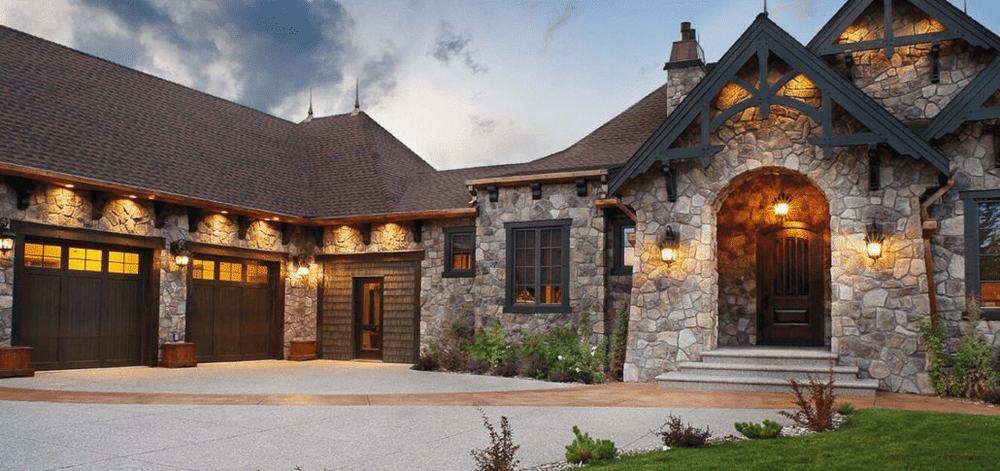
People shopping for cultured stone usually arrive with a picture and leave with a question about arithmetic. The look is the easy part. What decides whether an order is right is knowing that the product is sold in two different units, that one of them quietly covers some of the other, and that the wall behind it has requirements of its own.
VanderWall Brothers has supplied masonry materials in West Michigan since 1922, from showrooms in Spring Lake and Grand Rapids, so the notes below are the questions the counter actually gets.
Key Takeaways / Summary
- Cultured stone is cast concrete. Cement, aggregate, water and iron oxide pigment, wet-cast in molds taken from real stone. "Cultured," "manufactured" and "faux" all mean the same product.
- It is a standardized product, not a loose category. ASTM C1670 sets the limits, including a maximum thickness of 2.625 inches and a maximum face area of 5 square feet per piece.
- It is sold in two units. Flats by the square foot, corners by the linear foot. They are ordered separately and they are not interchangeable.
- Corners cover wall on two faces at once, so the corner footage has to come out of the flat footage or the order is too big.
- The wall behind it is half the job. Over wood framing, current guidance calls for two layers of water-resistive barrier, self-furring galvanized lath and a scratch coat before any stone goes up.
- Michigan is still on the 2015 Residential Code, because a 2025 court order stopped the 2021 rule set. Adhered veneer sits in section R703.12.
What Cultured Stone Actually Is
It is concrete, cast in a mold.
The mix is portland cement, normal or lightweight aggregate, water, admixtures and iron oxide pigments. The molds are taken from real stone, which is why a good product has the irregular faces, undercut edges and color variation of the thing it copies rather than a repeating pattern.
That is not a loose description. ASTM C1670, the standard specification for adhered manufactured stone masonry veneer units, covers the materials, the physical requirements, the dimensional allowances and the finish. The standard is worth knowing about, because it separates a product an architect will specify from something that is merely gray and textured. It sets a maximum thickness of 2.625 inches, a maximum face dimension of 36 inches, and a maximum face area of 5 square feet for any single piece. Installation has a standard of its own, ASTM C1780.
The reason those limits exist is weight. Cultured stone is an adhered veneer, which means it hangs on the wall the way tile hangs on a shower, held by mortar and by the lath behind it. Full-bed stone and full brick are a different animal: they sit on a footing, stand off the wall on ties, and have to be planned for before the foundation is poured. Cultured stone can go onto a house that is already built, which is most of why it exists.
There is a real trade in that. It is covered in manufactured stone versus real stone: cultured stone wins on weight and on consistency, natural stone wins on depth and on how it ages.
The Two Units It Is Sold In
This is where orders go wrong, so it is worth being slow about.
Flats are sold by the square foot. A flat is a piece with one finished face. It covers the field of the wall.
Corners are sold by the linear foot. A corner is a piece bent around an outside edge, with two finished faces meeting at roughly 90 degrees, so the corner of a column or a chimney chase reads as solid stone instead of showing the cut edge of a flat. There is no real substitute. Two flats mitered together never look right, because the joint sits exactly where the eye goes.
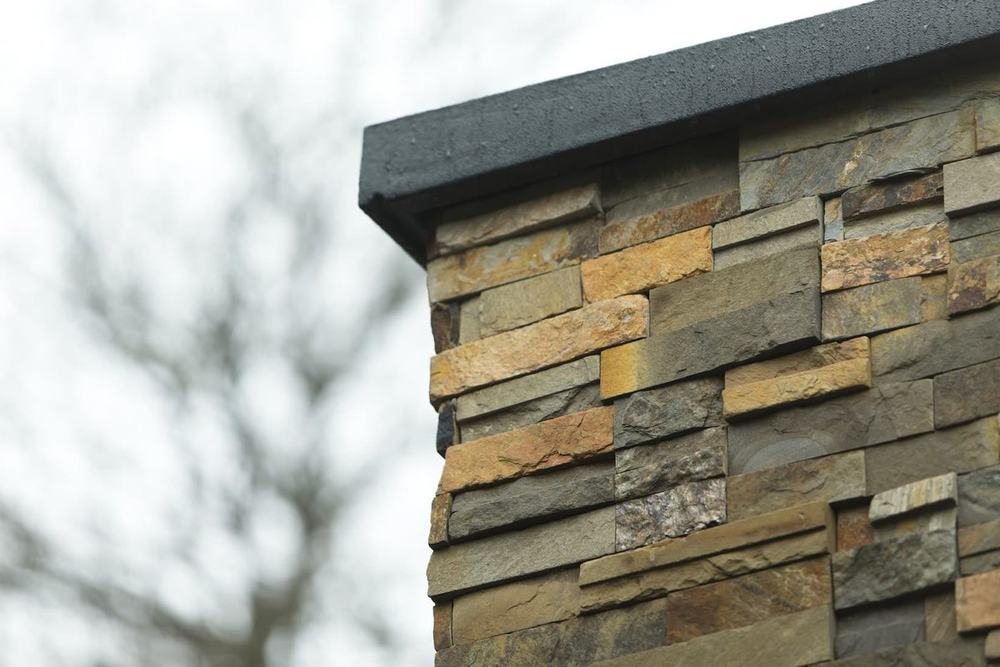
Here is the part that catches people. A linear foot of corner is not just a linear foot of edge. It also occupies wall on both sides of that edge, which means it covers field area that you already counted when you measured the flats. Manufacturers publish a conversion for this and it differs by profile, so use the number printed for the product you are buying rather than a rule of thumb. Whatever the figure is, it comes off the flat order.
Miss that step and the order is over by a meaningful amount on a job with several columns.
How to Measure Your Own Job
Anyone can get close enough for a real conversation. Five steps.
- Measure the flat area. Length times height for every surface being covered, in feet.
- Subtract the openings. Windows, doors, vents, the garage opening. Do not subtract anything smaller than about 2 square feet; it gets eaten by cuts.
- Measure the outside corners. Total the vertical height of every outside edge that will be stoned, in linear feet. That is the corner order.
- Take the corner coverage out of the flats. Multiply the corner linear footage by the manufacturer's published coverage figure, and subtract the result from the square footage in step 2.
- Add waste. Ten percent is normal. Fifteen is more realistic on a job with a lot of corners, arches, tight returns or a strong pattern that has to line up.
Bring those two numbers, flats in square feet and corners in linear feet, and the counter can talk about product instead of about geometry.
One more thing to settle at the same time: the joint. A dry-stacked look has no visible mortar between pieces and takes more stone per square foot because nothing is spaced out. A mortared joint at half an inch covers more wall with the same box and changes the color of the whole elevation, because a third of what you see becomes mortar. Decide it before ordering, not during.
The Wall Behind It Is Half the Job
Stone that fails almost never fails because of the stone.
Over wood framing, the current guide specification from the Concrete Masonry and Hardscapes Association calls for two layers of water-resistive barrier, installed shingle fashion with the upper layer lapping the lower, then self-furring galvanized metal lath at 2.5 pounds per square yard or heavier, then a scratch coat nominally half an inch thick that completely covers and engages the lath. Over cement board, one layer of barrier. The stone goes on last, onto that scratch coat.
The two-layer requirement is the one most often skipped. It is there for a specific reason. Cement-based veneer absorbs water. The inner layer is the drainage plane that gets the water back out at the flashing. One layer that is bonded to the scratch coat is not a drainage plane anymore, it is part of the wall.
Clearances matter too. Stone is kept 4 inches above finished grade over soil and 2 inches above pavement that is not supported by the same foundation. That gap looks like a detail nobody will notice. It is what keeps splash, snowmelt and de-icing salt out of the bottom course, and a plow pile against a garage pier sits there for weeks.
Which code applies right now. Michigan is still working to the 2015 Michigan Residential Code. A stipulated order from the Michigan Court of Claims in July 2025 stopped the Bureau of Construction Codes from implementing the 2021 rule set, so the 2015 edition remains in force while that litigation continues. Adhered masonry veneer is section R703.12.
Where It Works and Where It Does Not
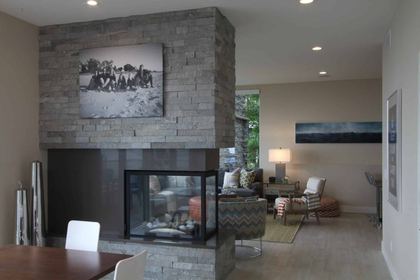
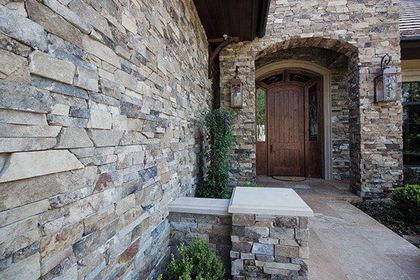
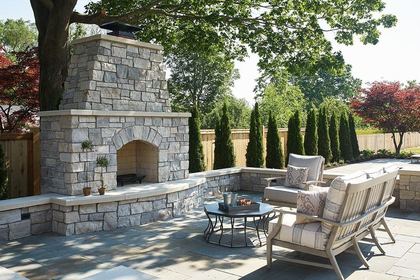
Cultured stone earns its place on chimney chases, entry columns, wainscot under siding, foundation faces, porch piers, outdoor kitchen bases and interior fireplace surrounds. Anywhere a wall wants the look of stone and cannot carry the weight of it.
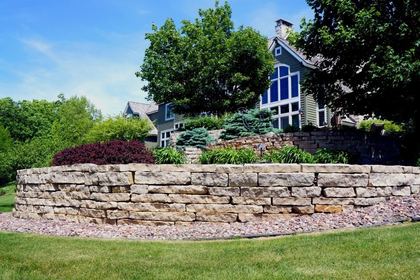
Where it struggles is predictable. It is not a below-grade product and it is not a retaining wall. It does not belong where irrigation sprays it daily or where a downspout dumps onto it. It does not want to be buried by a mulch bed that creeps up past the clearance line every spring. None of those are flaws in the material. They are all water, which is the only thing that beats it.
Color is its own decision and a bigger one than most people expect, because a sample board and a full elevation are not the same experience. That is worked through in how to choose stone veneer colors.
What to Bring to the Counter
- A photo of the wall, taken straight on, with something in frame for scale.
- Your two numbers: flats in square feet, corners in linear feet.
- Whether it is new construction or going onto an existing house, since that changes what is behind it.
- What the stone meets at the top and the bottom. Siding, trim, a soffit, grade, a slab.
- The joint you want, dry stack or mortared, and roughly what color mortar.
Where to Start
Both showrooms have full stone displays up, which is the only honest way to judge a profile: a 4 inch sample tells you the color and nothing about how the pattern reads across 30 feet of wall. Cultured stone covers the manufactured product, natural stone covers the quarried side, and masonry supplies covers the lath, barrier, mortar and accessories that go behind it.
Come to Spring Lake or Grand Rapids, or send the photo and the two numbers and the counter will work through it before anybody drives anywhere.
Sources
- ASTM International, C1670/C1670M, Standard Specification for Adhered Manufactured Stone Masonry Veneer Units, for the materials, the wet-cast method and the dimensional limits.
- Concrete Masonry and Hardscapes Association, Are There ASTM Standards for Manufactured Stone Veneer?, for the 2.625 inch maximum thickness, the 36 inch maximum face dimension and the 5 square foot maximum face area, and for ASTM C1780 covering installation.
- Concrete Masonry and Hardscapes Association, Adhered Manufactured Stone Veneer guide specification, for two layers of water-resistive barrier over light frame with lath, self-furring galvanized lath at 2.5 pounds per square yard, the nominal half inch scratch coat, and the 4 inch and 2 inch clearances.
- State of Michigan, Michigan Residential Code 2015, section R703.12, for adhered masonry veneer.
- Michigan Department of Licensing and Regulatory Affairs, Bureau of Construction Codes, for the court order that stopped the 2021 residential code rule set, leaving the 2015 edition in force.
Coverage figures for corner units differ by manufacturer and by profile. Use the number published for the product being bought.
What we do
This is work we take on
Reading up is the first step. When you want it built, priced or supplied, these are the pages that cover it.
Keep reading
What Is a Wood Stove?
There’s something about the warmth, coziness, and crackling of a wood fire that just can’t be beat. Fortunately, if…
Outdoor Fire Plans Heating Up Your Backyard
By the time spring comes around in full bloom, most people are more than eager to spend some well-deserved time in the…
Types of Common Patio Pavers
Patio pavers add a beautiful element to any garden, walkway, or patio. Today, there are endless possibilities when it…
Thinking about a project like this?
Reading about it only gets you so far. Tell us the room and we will tell you what is possible in it.
Rather just ask someone?
Call the showroom. If it takes two minutes on the phone we would rather tell you than have you read around it.