
Natural Gas vs. Propane Grill for an Outdoor Kitchen
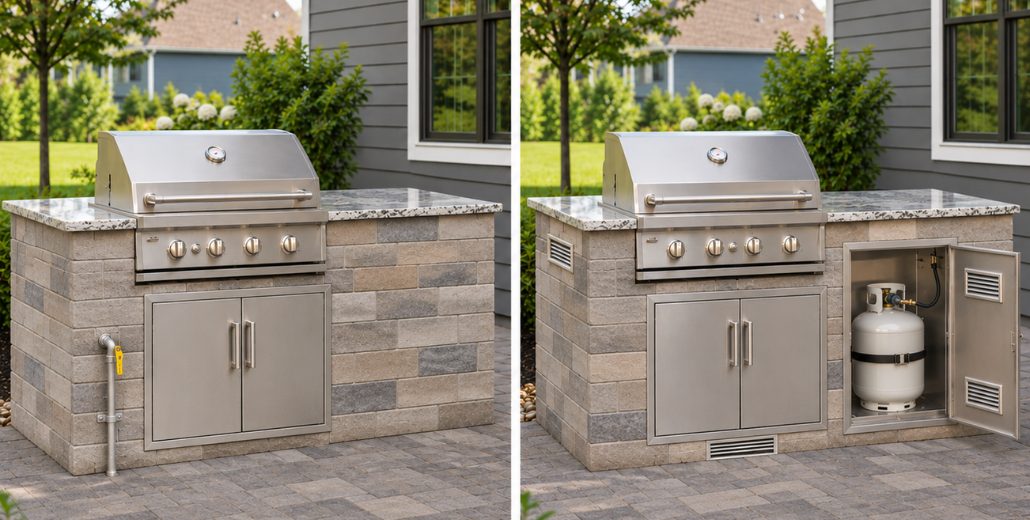
For a permanent outdoor kitchen, natural gas is often a practical choice when a suitable gas line already reaches the property. Propane may make more sense when natural gas is unavailable, the grill needs to remain flexible, or installing a new gas line would add too much to the project.
Neither fuel is automatically better for every West Michigan home. The most important decision is choosing a grill designed for the fuel you will actually use, then planning the island, utility connections, and ventilation around it.
Key Takeaways
- Natural gas suits many fixed outdoor kitchens. It connects to a properly designed permanent gas line, eliminating routine cylinder exchanges.
- Propane offers flexibility. It can be supplied by an approved portable cylinder or an appropriately installed bulk tank system, depending on the appliance.
- Choose the fuel before buying the grill. Natural gas and propane models are not automatically interchangeable.
- Compare total project costs. Line installation, fuel delivery, equipment, and frequency of use all matter.
- Ventilation and clearances are essential. The exact grill and fuel system determine the approved enclosure requirements.
Natural Gas vs. Propane Grill: What's the Difference?
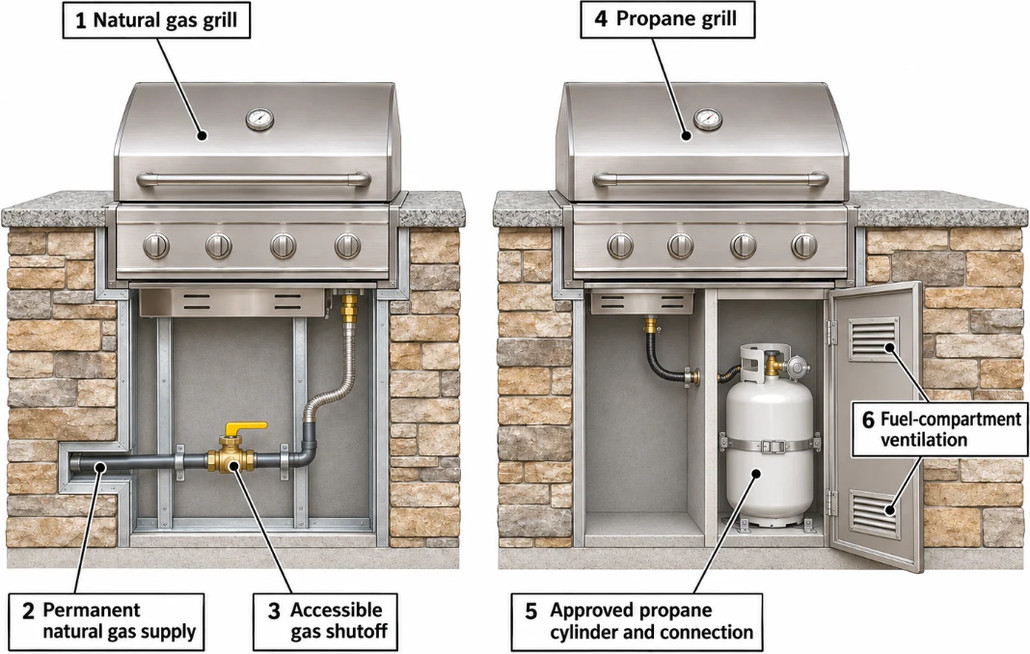
- Natural gas grill
- Permanent natural gas supply
- Accessible gas shutoff
- Propane grill
- Approved propane cylinder and connection
- Fuel-compartment ventilation
This is a conceptual illustration. Actual gas connections, cylinder placement, ventilation, and clearances depend on manufacturer requirements and applicable codes. Installation must be performed by qualified professionals.
A natural gas grill connects to a home's gas supply through an appropriately sized, professionally installed line. A propane grill uses liquefied petroleum gas delivered from an approved cylinder or tank system.
Both can produce dependable cooking heat when properly configured. The main practical differences are fuel availability, how the grill receives fuel, refilling needs, installation work, and operating costs.
Napoleon's natural gas versus propane guide discusses these trade-offs for homeowners considering a gas grill.
Quick Comparison for Outdoor Kitchens
| Decision | Natural Gas | Propane |
|---|---|---|
| Fuel source | Permanent gas supply line | Approved cylinder or tank supply |
| Refilling | No portable cylinder exchanges | Cylinder exchanges or fuel deliveries |
| Installation | Gas-line planning and connection | Approved regulator, supply and storage arrangement |
| Placement | Usually fixed near the installed line | Can offer more location flexibility |
| Operating cost | Depends on utility rates and usage | Depends on propane prices and usage |
| Grill model | Must be approved for natural gas | Must be approved for propane |
When Does Natural Gas Make More Sense?
Natural gas is worth considering when your outdoor kitchen will stay in one place and the home already has a suitable gas service.
It may be especially convenient if you cook outdoors often. You do not need to check a portable cylinder before a long gathering or interrupt cooking to exchange an empty tank.
However, a home with natural gas service does not necessarily have enough available gas capacity for a new grill, side burner, outdoor fireplace, and other appliances. A qualified gas professional should evaluate demand, line sizing, shutoffs, and the planned route before construction.
Practical tip: Identify the exact grill and any other gas appliances before designing the gas line, rather than sizing the supply from a general outdoor kitchen sketch.
When Is Propane the Better Fit?
Propane can be a practical option when a natural gas connection is unavailable or the cost of extending one is not justified for the intended use.
A freestanding propane grill is often easier to relocate. Some built-in outdoor kitchen grills also offer approved propane configurations, but the cylinder or tank arrangement must comply with the manufacturer's instructions and applicable requirements.
For a permanent island, consider how you will access the fuel supply, change cylinders where permitted, and maintain the required ventilation and service access. A propane tank should not simply be hidden in an unventilated cabinet.
Practical tip: Plan any cylinder compartment or external tank location before finalizing cabinetry, doors, stonework, and surrounding circulation.
Which Fuel Costs Less?
There is no single installed-price answer for every West Michigan property.
Natural gas may offer lower ongoing fuel costs in some markets, but extending a line across a patio or yard can add significant upfront work. Propane may require less initial infrastructure when an approved tank arrangement is already available, but refills and deliveries continue over time.
Compare these costs together:
- The natural gas and propane versions of the selected grill
- Gas-line work, permits, and required inspections
- Propane cylinder or bulk-tank supply arrangements
- Additional side burners and other gas appliances
- Expected grilling frequency and current local fuel rates
Ask for a complete project-specific estimate instead of relying on a generic cost-per-hour figure.
Can a Propane Grill Be Converted to Natural Gas?
Sometimes, but only if the specific manufacturer and model permit conversion using approved components and instructions. Some grills are sold for one fuel only.
For example, Napoleon's grill support guidance identifies certain convertible models and states that approved conversion kits must be installed by a locally licensed gas technician. Weber's conversion guidance explains why it does not authorize fuel conversions for its North American grills.
Do not assume that changing a hose, regulator, or burner orifice yourself makes a grill compatible with another fuel. Incorrect conversion can create dangerous combustion or gas-leak conditions.
What Changes in a Built-In Grill Island?
Fuel selection affects the island long before the first meal is prepared.
Confirm the appliance's:
- Fuel-specific model number and cutout dimensions
- Approved gas-supply and shutoff location
- Required enclosure ventilation openings
- Clearances and any insulating-jacket requirements
- Access for servicing and fuel replacement, if applicable
Vent openings within an island are not the same as an exhaust hood above a grill. Both have separate purposes and product-specific requirements.
If the kitchen will sit beneath a roof, VanderWall's guide to outdoor kitchens under covered patios explains why overhead construction and airflow must be reviewed together.
What If You Plan to Add More Appliances Later?
A built-in grill may be the first component, but future side burners, pizza ovens, or outdoor heaters can change the overall utility plan.
Discuss possible additions before completing the island or patio. An early conversation may prevent having to reopen finished hardscape or masonry when the project expands.
VanderWall's outdoor kitchen appliance planning guide explains why specifications and utility locations should be confirmed before cabinetry and masonry are built.
Which Grill Fuel Should You Choose?
If you have suitable natural gas service and plan a permanent kitchen used frequently, a natural gas grill may be the more convenient choice. If a gas line is unavailable or you prefer a flexible setup, a properly specified propane grill may be a better fit.
The decision starts with the property, how you cook, and the exact grill you want to buy. Fuel availability, supply requirements, ventilation, and total cost should all be reviewed before ordering.
VanderWall Brothers carries outdoor grills and kitchen products for West Michigan homes. Bring photos, site dimensions, and any existing gas-service information to the Spring Lake or Grand Rapids showroom, or contact the VanderWall team to compare options and discuss your project.
What we do
This is work we take on
Reading up is the first step. When you want it built, priced or supplied, these are the pages that cover it.
Keep reading
Can You Put an Outdoor Kitchen Under a Covered Patio?
Yes, an outdoor kitchen can often be built under a covered patio, but adding a roof changes how the grill, ventilation…
Can Thin Brick Be Installed Over Drywall?
Yes, thin brick can sometimes be installed over drywall, but only when the selected thin-brick system, adhesive or…
Does a Gas Fireplace Need a Hearth?
A gas fireplace does not always need a projecting hearth in front of it.
Thinking about a project like this?
Reading about it only gets you so far. Tell us the room and we will tell you what is possible in it.
Rather just ask someone?
Call the showroom. If it takes two minutes on the phone we would rather tell you than have you read around it.