

How Much a CMU Block Weighs and Measures, Width by Width
A block has no single weight. It has a width, a density and a shape, and all three move the number. That matters to a mason pricing labor, to an estimator working out a truckload, and to anyone deciding how an order gets to the wall.
This page gives the general weight of VanderWall Brothers block at each width, the dimensions that go with it, how many units come on a pallet, and how an order reaches a job site. It builds on two earlier pieces: the guide to buying concrete block in West Michigan, which covers shapes, counts and ordering, and the longer explainer on what a CMU is.
Key Takeaways / Summary
- A standard 8 inch block weighs about 34 to 36 pounds. That is the general range for VanderWall Brothers' cored 8 inch unit.
- Width moves the weight most. The same range runs from about 22 pounds at 4 inch to about 55 pounds at 12 inch.
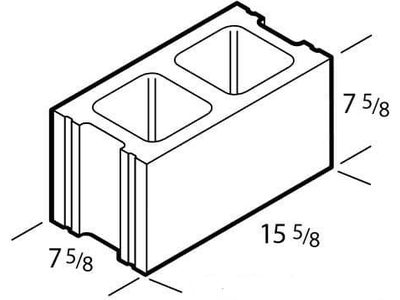
- Every width is the same height and length. A block is 7 5/8 inches tall and 15 5/8 inches long. Only the thickness changes.
- Density is a class, set by ASTM. Lightweight, medium weight and normal weight are defined by the concrete, not by the size of the unit.
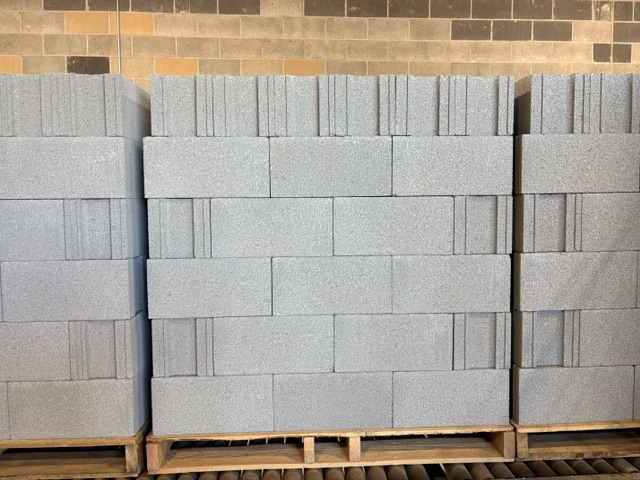
- Pallet counts drop as the block gets wider. 180 units at 4 inch down to 65 at 12 inch, and partial pallets are sold.
- A full pallet runs a ton and a half to two tons. That is why block is delivered and set on site with a forklift.
What Each Width Weighs
These are VanderWall Brothers' general weights for cored block, by nominal width. They are ranges on purpose. The exact weight of a unit depends on its density class and its shape, and the counter can speak to the specific block on your order.
| Nominal width | General weight per block |
|---|---|
| 4 inch | 22 to 24 lb |
| 6 inch | 27 to 29 lb |
| 8 inch | 34 to 36 lb |
| 10 inch | 44 to 46 lb |
| 12 inch | up to about 55 lb |
Read down the column and the pattern is steady: each 2 inch step in width adds roughly 5 to 10 pounds a unit.
These are hollow units as they leave the plant. A wall is a different number. Once cells are grouted and steel goes in, the weight of the finished wall is driven mostly by the grout, and that figure belongs to the engineer.
Why One Block Can Have More Than One Weight
Concrete block is sorted into three density classes by ASTM C90, the standard for loadbearing units. The classes are set by the oven-dry density of the concrete:
- Lightweight: less than 105 pounds per cubic foot
- Medium weight: 105 to less than 125 pounds per cubic foot
- Normal weight: 125 pounds per cubic foot or more
Density is only part of it. The Concrete Masonry and Hardscapes Association puts the rest plainly: the weight of a given unit is influenced by both the density and the overall volume of material used to make it. Face shells, webs and cores differ from one shape to the next, so a bond beam unit and a stretcher of the same width do not weigh the same.
The weights and other physical properties of a specific unit are established by testing under ASTM C140, the standard test method for concrete masonry units. VanderWall Brothers provides its C140 reports to business customers on request. If a project specification calls for one, ask for it with the order.
The Size of a CMU Block, by Width
Block is named by nominal dimensions and made 3/8 inch smaller, so that one unit plus one mortar joint comes out to a round number. That rule applies in all three directions.
| Nominal size | Actual thickness | Actual height | Actual length |
|---|---|---|---|
| 4 x 8 x 16 | 3 5/8 in. | 7 5/8 in. | 15 5/8 in. |
| 6 x 8 x 16 | 5 5/8 in. | 7 5/8 in. | 15 5/8 in. |
| 8 x 8 x 16 | 7 5/8 in. | 7 5/8 in. | 15 5/8 in. |
| 10 x 8 x 16 | 9 5/8 in. | 7 5/8 in. | 15 5/8 in. |
| 12 x 8 x 16 | 11 5/8 in. | 7 5/8 in. | 15 5/8 in. |
So the answer to how tall a CMU block is does not depend on which one you buy. It is 7 5/8 inches, and a laid course rises 8 inches with its joint. The thickness of a block and its width are the same measurement. A "12 inch block" is 11 5/8 inches through the wall.
How Block Is Made
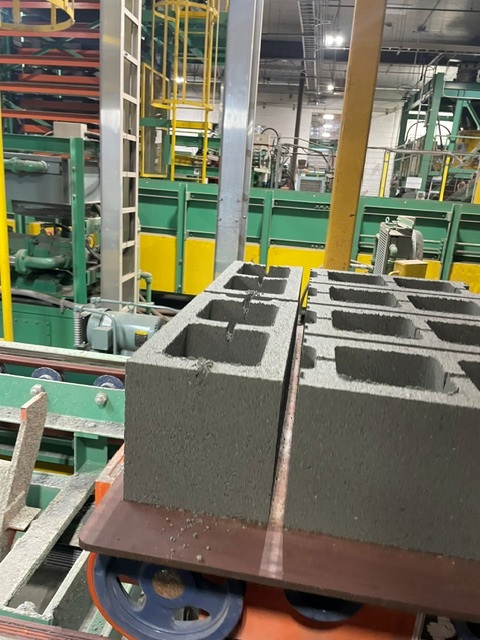
Each unit is molded, not cut. Concrete is pressed into a steel mold, and the fresh block is pushed out onto a steel pallet and carried off to cure. The mold sets the width and the shape, which is why every unit in a run matches the next one.
How Many Blocks Come on a Pallet
Block ships on pallets. The count depends on the width of the block and on the pallet itself, so treat these as the general numbers:
| Nominal width | Units per pallet | Approximate pallet weight |
|---|---|---|
| 4 inch | 180 | 3,960 to 4,320 lb |
| 6 inch | 120 | 3,240 to 3,480 lb |
| 8 inch | 90 | 3,060 to 3,240 lb |
| 10 inch | 80 | 3,520 to 3,680 lb |
| 12 inch | 65 | up to about 3,575 lb |
The pallet weights are simple arithmetic: units per pallet times the general weight per block, before the wood. Whatever the width, a full pallet lands between a ton and a half and a little over two tons.
You do not have to buy in full pallets. VanderWall Brothers sells partial pallets, so the order comes down to the number of units the job actually needs. The block guide shows how to get that number from the wall dimensions.
How a Block Order Reaches the Job
At a ton and a half or more per pallet, block is a delivered product. VanderWall Brothers delivers on its own trucks, and the pallets are set on site by forklift rather than by hand.
Three things make a delivery go smoothly. Have them ready when you call:
- Where the truck can get in. A loaded flatbed needs a firm approach and room to turn.
- Where the pallets should land. As close to the wall as the ground allows, so the block is not handled twice.
- Whether the ground will hold them. Pallets this heavy need firm, level ground.
For a small quantity picked up at the yard, check the vehicle before the block. Federal safety standards require a tire and loading placard on the driver's side door post or door edge, and it states the most that occupants and cargo can weigh together. At 34 to 36 pounds a unit, a few dozen 8 inch blocks reach that number quickly.
Lightweight Block and the Mason's Day
Hauling is one reason weight matters. Laying is the other. The same association notes that lower unit weights typically let a mason lay more units in a given time. A few pounds a block is nothing once. It is a real difference across several hundred units, each lifted to the wall by hand.
Whether lighter block suits the job is not only a comfort question. Density also bears on fire ratings, sound and structural design, so on an engineered wall the density class is on the plans. Bring that page with you.
What to Have Ready When You Call
- The width and the density class, or the plan page that names them.
- The unit count, including corners, bond beam and lintel units.
- Whether you need a C140 report for the specification.
- The delivery site: access, where the pallets go, and the date you need them.
- The rest of the order. Mortar, sand, reinforcement and ties come off the same ticket.
VanderWall Brothers has made concrete block in West Michigan since 1922. The standard CMU block page shows the units by width, the concrete products page covers the wider range, and masonry supplies covers what goes with them. Stop in at Spring Lake or Grand Rapids, or send the block count and ask for it delivered.
Sources
- VanderWall Brothers, for the general weight ranges by width, the units per pallet, partial pallet sales and the availability of C140 reports to business customers.
- ASTM International, C90 Standard Specification for Loadbearing Concrete Masonry Units, for the three density classes.
- ASTM International, C140 Standard Test Methods for Sampling and Testing Concrete Masonry Units and Related Units, for how the weight and physical properties of a unit are established.
- Concrete Masonry and Hardscapes Association, CMU-TEC-001-23, Concrete Masonry Unit Shapes, Sizes, Properties, and Specifications, for the 3/8 inch difference between nominal and specified dimensions, unit weight depending on both density and the volume of material, and lower unit weights allowing a mason to lay more units.
- Concrete Masonry and Hardscapes Association, CMU-TEC-002-23, Weights and Section Properties of Concrete Masonry Assemblies, for finished wall weight depending most on grout, unit density and unit size.
- Code of Federal Regulations, 49 CFR 571.110, section S4.3, for the vehicle placard, where it is mounted, and its statement of the combined weight of occupants and cargo.
Weights and pallet counts here are general figures for planning. They are not a load rating for any vehicle and not a substitute for the plans, the engineer or the figures for the specific unit on your order.
What we do
This is work we take on
Reading up is the first step. When you want it built, priced or supplied, these are the pages that cover it.
Keep reading
Practice Fireplace Safety to Enjoy a Cozy Winter
Cozy season is officially here, and that means it’s time to make sure your fireplace is in safe operating condition. By…
How to Create a Cozy Outdoor Space for Fall
Temperatures are dropping, leaves are turning, and the sun is setting earlier. After a hectic summer, fall is the…
All About Backyard Outdoor Fireplaces
When the seasons change and the cool breeze starts to set in, there’s nothing quite as inviting as the warm flicker of a…
Thinking about a project like this?
Reading about it only gets you so far. Tell us the room and we will tell you what is possible in it.
Rather just ask someone?
Call the showroom. If it takes two minutes on the phone we would rather tell you than have you read around it.