
Can You Put a TV Above a Gas Fireplace?
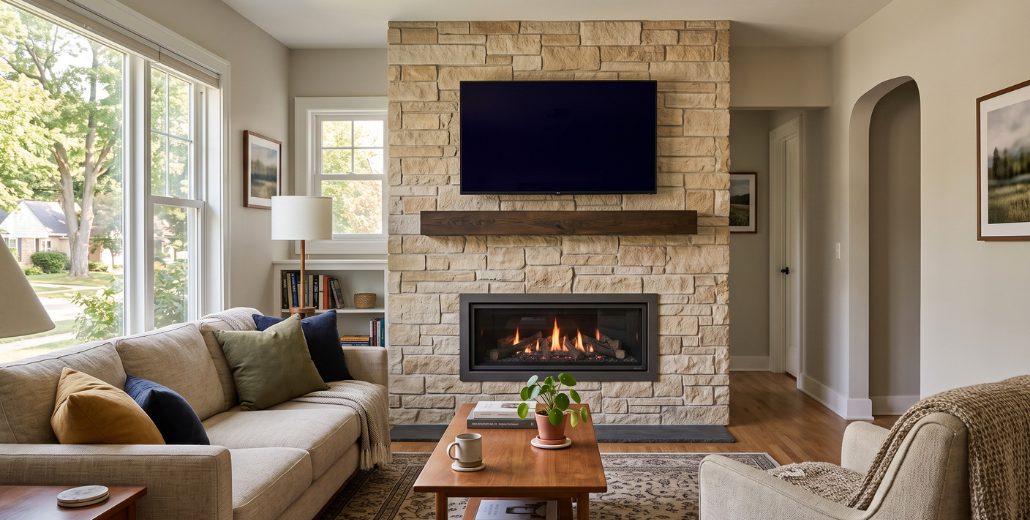
Yes, a television can often be installed above a gas fireplace, but the wall should be designed for that combination from the beginning.
The right setup depends on the exact fireplace model, how heat moves away from the fireplace, manufacturer clearances, mantel or heat-management options, television requirements, wall construction, and viewing height.
There is no universal measurement that works for every fireplace and television.
If a TV is part of the plan, tell your fireplace dealer, builder, and installer before the fireplace is selected and before the feature wall is framed.
Key Takeaways / Summary
- A TV can often go above a gas fireplace. The fireplace and wall must be designed to manage heat appropriately.
- Do not rely on one universal clearance number. Requirements vary by fireplace model, installation instructions, heat-management system, mantel design, and TV specifications.
- Modern heat-management systems can create more flexibility. Some fireplaces are specifically designed to reduce temperatures above the unit so televisions and heat-sensitive finishes can be placed closer.
- Viewing height matters too. A thermally safe TV can still be uncomfortable if the fireplace and mantel push the screen too high.
- Plan electrical and cable locations before closing the wall. Power, data, blocking, framing, and service access are easier to coordinate before finish materials are installed.
Heat Is the First Design Question
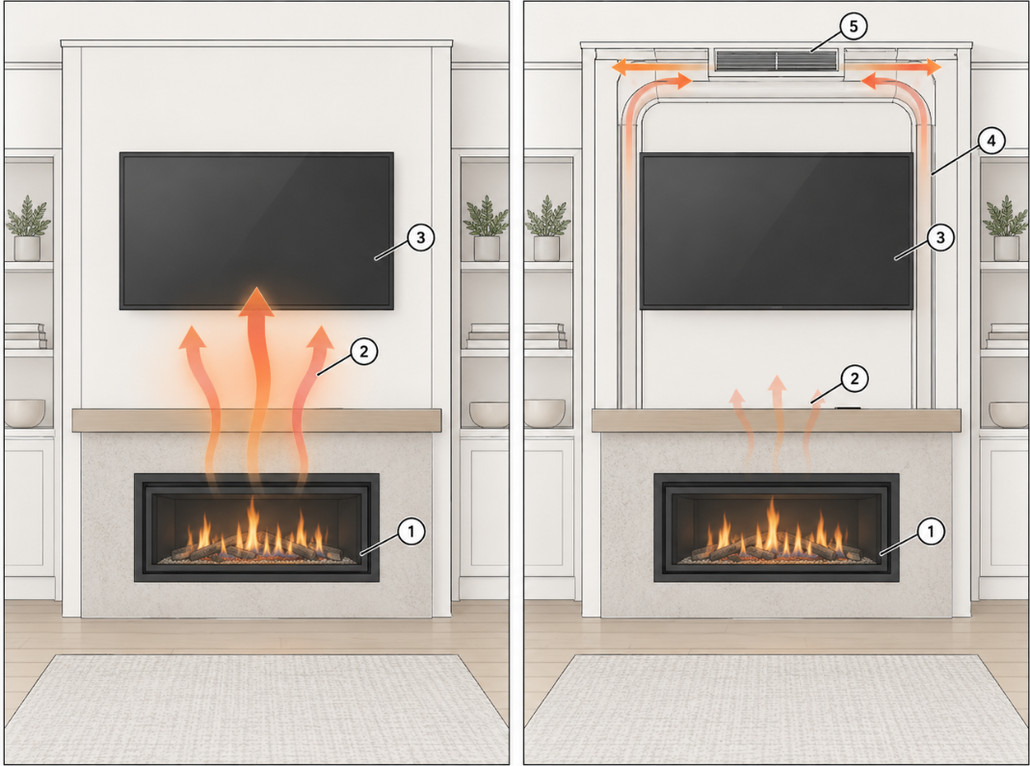
- Gas fireplace
- Natural heat path
- Television location
- Heat-management pathway
- Redirected warm air
A gas fireplace is a heating appliance. Warm air and radiant heat can affect the wall above the fireplace, which is often exactly where homeowners want to place a television.
The amount and direction of heat depend on the fireplace design.
Some models send more heat toward the front of the room. Others offer manufacturer-designed systems that redirect or redistribute heat before it reaches the upper portion of the fireplace wall.
Kozy Heat, VanderWall's primary fireplace line, offers models such as the Callaway 50 with optional heat-management systems specifically designed to reduce heat above the fireplace and accommodate a television.
Practical tip: If a TV is non-negotiable, make that part of the fireplace-selection conversation rather than choosing the fireplace first and trying to solve the heat afterward.
There Is No Universal TV Clearance
Online advice often recommends one fixed distance between a fireplace and television.
That can be misleading.
The correct location depends on the installation manual for the exact fireplace and the requirements supplied by the television manufacturer.
Heatilator's TV-above-fireplace guidance specifically recommends following both the fireplace manufacturer's minimum clearances and the television manufacturer's specifications.
Fireplace requirements can also change when a mantel, heat-management kit, recessed TV pocket, or different finish material is added.
Practical tip: Do not let framing begin from a generic fireplace size or internet clearance chart. Use the current manual for the exact model being installed.
What Is Fireplace Heat Management?
Heat management refers to manufacturer-designed methods of controlling where heat from the fireplace travels.
Depending on the fireplace, the system may redirect warm air through an opening higher on the wall, toward another part of the room, into another area of the home, or through another approved pathway.
Napoleon explains that its fireplace heat-management systems can reduce clearances to combustible materials and allow televisions and artwork to be installed closer to compatible fireplaces.
Kozy Heat's Callaway series similarly offers its Komfort Zone Kit and vented-cavity configurations for reduced heat above the fireplace.
These systems are product-specific. A heat-management approach from one fireplace should not be assumed to work with another model.
Does a Mantel Protect the TV?
A mantel can affect the way heat moves away from the fireplace, and some manufacturers provide specific mantel-clearance charts based on mantel depth and location.
However, a mantel is not a universal heat shield.
Its allowable position depends on the fireplace, materials, projection, and installation requirements.
Some modern fireplaces with approved heat-management systems can accommodate a TV without a traditional mantel. Other fireplace designs may incorporate a mantel as part of the required or preferred wall configuration.
The correct approach should come from the fireplace manual rather than a general rule about how deep a mantel should be.
Viewing Height Matters as Much as Heat
Even when the fireplace manufacturer allows a television above the unit, the finished screen can end up higher than the homeowner expects.
The final height is influenced by:
- Fireplace height
- Hearth height
- Required space above the fireplace
- Mantel placement
- TV size
- TV mount
- Seating distance
A lower-profile fireplace can help reduce the overall height of the feature wall.
Kozy Heat's Bellingham 44, for example, is specifically described as a lower-profile traditional fireplace designed to work with a TV above it.
Practical tip: Before framing, mark the proposed bottom and top edges of the TV on the wall with painter's tape. Sit in the room where the furniture will be and make sure the viewing position feels comfortable.
Choose the Fireplace Before Finalizing the Wall
A fireplace should not be represented on the construction plan simply as a generic rectangle.
The exact model determines important details including:
- Framing width and height
- Fireplace depth
- Venting
- Heat-management options
- Combustible clearances
- Finishing requirements
- Mantel limitations
- Service access
This is why VanderWall recommends comparing actual gas fireplace options before the feature wall is finalized.
The television, stone, cabinetry, and fireplace can then be designed around confirmed product information.
Plan Wiring and Wall Construction Early
The television introduces electrical and low-voltage requirements that should be coordinated with the fireplace framing.
Before the wall is closed, decide:
- Where the TV outlet will be located
- How HDMI or data cables will be routed
- Whether future cable replacement will be possible
- Where blocking for the TV mount is required
- Whether the TV will be recessed
- Where sound equipment will go
- How fireplace service access will remain available
A stone or brick feature wall makes later changes more difficult, so these decisions are particularly useful before masonry begins.
Practical tip: Photograph the open wall after electrical, blocking, and fireplace framing are complete. Those photos can help locate wiring and framing after the wall has been finished.
Be Careful With Recessed TV Designs
A recessed television can create a clean appearance, but the recess changes the wall geometry and can affect how heat collects around the screen.
Some fireplace manufacturers provide specific details for TV recesses when certain heat-management systems are installed.
That means a recess should be designed from approved fireplace documentation rather than framed simply because there appears to be enough space.
The television manufacturer may also have ventilation requirements that need to remain unobstructed.
Think About the Finish Material Too
Stone, brick, tile, drywall, wood panels, and other finishes can all change how a fireplace wall is constructed.
Some materials are combustible. Others are noncombustible but may still have installation limitations around the fireplace.
Requirements vary by fireplace model, heat-management configuration, finish material, and manufacturer instructions.
If stone or brick will surround the fireplace, coordinate its thickness and support before the TV location is finalized.
What About an Existing Gas Fireplace?
Adding a TV above an existing fireplace requires a different approach because the fireplace and wall are already built.
Identify the exact fireplace brand and model first.
Then locate the installation manual and review:
- Clearances above the fireplace
- Existing mantel requirements
- Current wall temperature and heat path
- Finish materials
- Available framing for a TV mount
- Electrical access
Do not assume that a newer TV-above-fireplace detail can simply be added to an older fireplace that was not designed around the same heat-management system.
Questions to Ask Before Building the Fireplace TV Wall
- What exact fireplace model are we using?
- Does it offer an approved heat-management system?
- What does its manual allow above the fireplace?
- Does the TV manufacturer specify temperature or ventilation limits?
- Will there be a mantel?
- What will the final TV height be?
- Is the viewing angle comfortable from the sofa?
- Where will power and data cables run?
- Is proper blocking included for the TV mount?
- Will stone or another thick finish affect the wall depth?
- Can the fireplace still be serviced after everything is installed?
See the Fireplace Before Designing Around It
Fireplace dimensions on a drawing can be difficult to visualize, especially when a large television will sit above the unit.
Homeowners can compare operating fireplaces in person at VanderWall's Spring Lake and Grand Rapids showrooms.
VanderWall is the area's Kozy Heat dealer and also carries brands including Napoleon, Regency, Ortal, Kingsman, Marquis, and others.
Bring the TV size, a photo of the room, approximate wall measurements, and any plans for stone, cabinetry, or built-ins. Those details make it easier to select a fireplace that works with the entire wall rather than solving each element separately.
Design the Fireplace and TV as One Wall
A television above a gas fireplace can work well when both are planned as parts of the same system.
The fireplace model determines how heat, framing, venting, and finishing need to be handled. The television introduces viewing height, wiring, ventilation, and mounting requirements.
Choosing the exact fireplace early allows those requirements to be coordinated before the framing and finish materials make changes more difficult.
If you are planning a fireplace and television on the same wall, talk with the VanderWall team. Bring your room dimensions and TV size, and the team can help you compare fireplace options and heat-management configurations that fit the project.
What we do
This is work we take on
Reading up is the first step. When you want it built, priced or supplied, these are the pages that cover it.
Keep reading
Patio Pavers: Which type is right for my home?
Patio pavers add a beautiful element to any garden, walkway, or patio. Today, there are endless possibilities when it…
Gas Fireplace Inserts: Everything You Need To Know
Michigan is known for its harsh weather, and it is not uncommon for temperatures to drop well below freezing during the…
How Much a CMU Block Weighs and Measures, Width by Width
A block has no single weight. It has a width, a density and a shape, and all three move the number. That matters to a…
Thinking about a project like this?
Reading about it only gets you so far. Tell us the room and we will tell you what is possible in it.
Rather just ask someone?
Call the showroom. If it takes two minutes on the phone we would rather tell you than have you read around it.